
The Women Who Kept Irish Memory Alive
Some histories are written in books. Others are carried quietly through families.
In Irish heritage, women have often been the keepers of memory. They carried stories, songs, prayers, recipes, names, photographs, letters, and traditions from one generation to the next. Their work was not always recorded in official histories, but without them, much of Irish cultural memory would have disappeared.
To understand Irish heritage properly, we need to look not only at famous leaders and public events, but also at the women who held families and communities together.
The Quiet Work of Remembering
In many Irish families, women were the ones who remembered birthdays, baptisms, marriages, deaths, family connections, and old stories. They knew who was related to whom, which townland a family came from, where someone was buried, and which relative had emigrated overseas.
This kind of knowledge may seem ordinary, but it is central to family history.
Before digital records and online genealogy websites, family memory often lived through conversation. It was shared at kitchen tables, after Mass, during family gatherings, or through letters sent across oceans. Women often became the link between past and present, keeping names alive even when written records were incomplete.
For descendants of Irish emigrants, these fragments can become precious. A story told by a grandmother, a photograph kept in a drawer, or a family prayer remembered from childhood may become the starting point for tracing Irish roots.
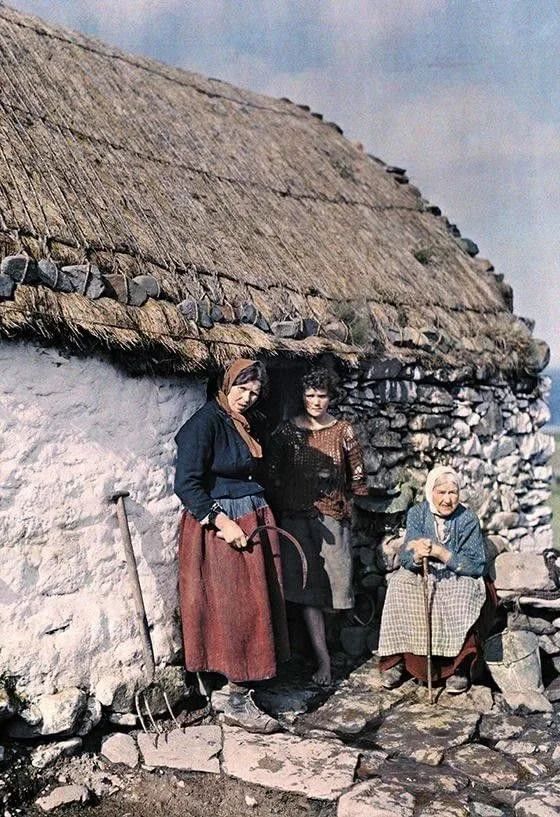
Three generations of women stand outside their stone cottage, Connemara. 1920's
Women and the Irish Diaspora
When Irish people emigrated to Australia, America, Canada, Britain, and New Zealand, women carried culture with them in powerful ways. They helped maintain Irish identity through family life, religion, food, music, storytelling, and community networks.
In a new country, Irish identity often survived through small domestic rituals. A song sung at home. A saint’s day remembered. A family recipe adapted to new ingredients. A story about “home” told to children who had never seen Ireland.
These details matter because heritage is not only preserved in monuments. It is also preserved in everyday life.
Hidden Lives in Family History
Genealogy can sometimes make women harder to trace. Surnames changed after marriage. Records may list women only in relation to husbands or fathers. Their individual stories may be less visible in official documents.
But absence does not mean insignificance.
In fact, women’s lives often reveal some of the most human parts of family history: migration, childcare, work, faith, grief, resilience, and survival. A woman’s story may show how a family adapted after emigration, how traditions were preserved, or how children were raised with a sense of Irish belonging.
Remembering With Respect
To explore women’s place in Irish heritage is to recognise that history is not only public and political. It is also intimate and personal.
Women kept memory alive through care, storytelling, and continuity. They preserved culture in ways that were not always celebrated, but were deeply important. Their stories help us understand Ireland not only as a nation, but as a network of families, communities, and remembered places.
At The Celtic Way, we believe heritage travel should honour these quieter histories. When we visit Ireland, we are not only looking at landscapes and buildings. We are also listening to the lives that shaped them.
Follow The Celtic Way for more stories of Irish heritage, family memory, and meaningful travel: https://www.thecelticway.com.au/